DEFINITION
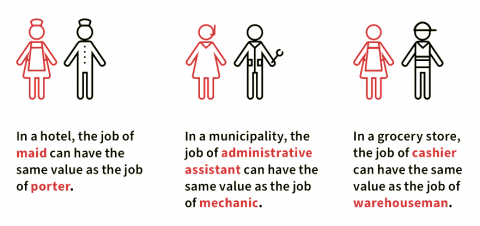
Pay equity is equal pay for work of equal or comparable value. It is about the value of jobs traditionally and predominantly held by women.
COMPARING JOBS
To ensure pay equity, one compares the value of jobs traditionally or predominantly held by women (or female jobs) to the value of jobs traditionally or predominantly held by men (or male jobs).
The comparison is based on four factors:
- skill,
- responsibility,
- effort, and
- working conditions.
A female job which is approximately equal in value to a male job must be subject to the same pay rate.
For example:
Say we compare the pay given to a secretary (a job traditionally done by women) and a technician (a job mostly done by men).
WAGE GAP
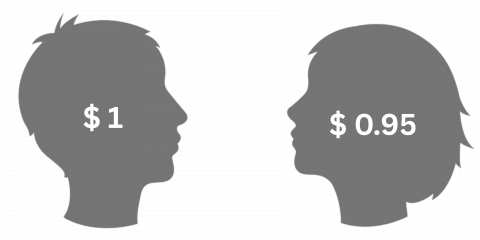
Pay inequity contributes to the wage gap, but so do those other factors. However, a study by economist Ather Akbari (2004) showed that 80% of the wage gap in New Brunswick is due to discrimination.
In 2010, in New Brunswick (according to Statistics Canada, 2011):
- Average hourly rate for MEN: $20.22
- Average hourly rate for WOMEN: $17.83
- The wage gap between men and women is therefore $2.39 in 2010. Women's average hourly wage was 88% of men's.
EQUAL PAY or WAGE PARITY
Equal pay or wage parity is defined as equal pay for equal work.
For example:
- Men and women working as nurses receive the same pay.
- Professors at a university in New Brunswick receive the same pay as their counterparts in Nova Scotia.
EMPLOYMENT EQUITY
At the recruitment, hiring, and promotion stages, employment equity aims at developing a representative workforce and eliminating discrimination against the members of certain designated groups such as aboriginal peoples, visible minorities, persons with disabilities, and women.
For example:
A company would ensure that its workforce is proportionately representative of the four groups mentioned above.
|